English
 Español
 Português
 Deutsch
 한국어
한국어 日本語
日本語 Italiano
 Français
 العربية
 Türkçe
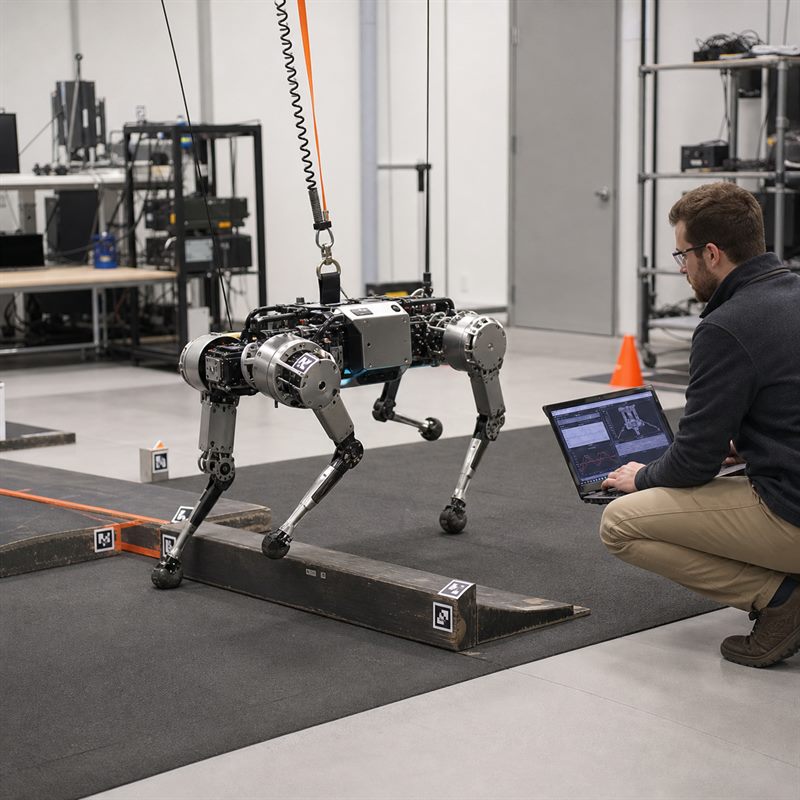
Robot motion control turns high-level intent into stable physical movement. The challenge is not only calculating a path, but executing that path through motors, joints, sensors, and feedback loops at real-time speed.
How Do Robots Control Their Limbs?
A robot limb is usually built from links, joints, motors, reducers, sensors, and controllers. When a robot receives a command such as “pick up the object,” the system must decide where to move, how each joint should rotate, how much force to apply, and how to correct motion when reality differs from the plan.
This process includes kinematics, dynamics, trajectory planning, actuator control, and closed-loop feedback. For high-DOF robots such as humanoids, quadrupeds, dexterous hands, and collaborative arms, the difficulty grows quickly as joint count and interaction complexity increase.
Kinematics vs. Dynamics
| Control Layer | Key Question | Example |
|---|---|---|
| Kinematics | Where should each joint move? | Calculating joint angles for a robot arm to reach a target point |
| Dynamics | How much force, torque, and timing are needed? | Maintaining balance, controlling acceleration, or applying grasp force |
| Feedback Control | How should the robot correct errors? | Using encoders, IMUs, force sensors, and motor feedback to adjust movement |
Why Closed-Loop Feedback Is Essential
The physical world is never perfectly predictable. Motors heat up, loads change, surfaces slip, parts flex, sensors drift, and external disturbances appear. A robot therefore needs closed-loop feedback: it constantly compares planned movement with actual movement and corrects the difference.
In many robots, feedback loops run hundreds or thousands of times per second. This is why real-time control matters. If the control system responds too late, the robot may vibrate, overshoot, lose balance, damage a part, or fail to grasp an object.
The Brain-Cerebellum Gap in Robot Motion
High-level AI is good at perception and planning, but motor control needs deterministic timing. The “brain” may decide what the robot should do, while the “cerebellum” must execute the motion precisely and continuously.
A strong robot architecture connects these layers without mixing their responsibilities. The decision layer can focus on perception, intent, and planning. The control layer can focus on actuator timing, bus communication, and feedback correction.
Understands the task, selects actions, plans paths, and updates behavior based on perception.
Executes motion commands through real-time loops, actuator buses, motor control, and feedback correction.
Short Answer
Robot limb control requires kinematics, dynamics, real-time feedback, and actuator communication. The most reliable systems separate AI planning from deterministic motion execution while keeping both layers tightly coordinated.
Hardware Requirements for Real-Time Robot Motion Control
- Real-time operating system support, such as Xenomai or equivalent real-time architecture.
- Industrial motion buses such as EtherCAT, CAN FD, or RS485, depending on actuator design.
- Low and predictable latency between command generation and actuator response.
- High-frequency feedback processing from encoders, IMUs, force sensors, or motor drivers.
- Enough local compute to coordinate multiple joints without delaying control loops.
- Thermal and power behavior suitable for continuous robot operation.
Relevant MScape Platforms
- MScape T40/T41: focused real-time robot motion controller for actuation systems.
- MScape T80: balanced brain-cerebellum robot controller for data acquisition and control scenarios.
- MScape T200: AI compute and control platform for robots needing stronger local intelligence and execution coordination.
- MScape N100: compact robot controller for embodied intelligence platforms.
Application Examples
Real-time motion control is especially important for quadruped robots, bipedal humanoid robots, dexterous robot hands, and collaborative robots.
FAQ
Why is robot motion control harder with more degrees of freedom?
Each additional joint increases the number of variables the controller must coordinate. High-DOF robots require synchronized control across many actuators while maintaining stability, timing, and safety.
Can AI replace real-time control?
No. AI can improve perception, planning, and adaptation, but physical execution still requires deterministic control loops, actuator feedback, and timing guarantees.
What is the best architecture for robot motion control?
A practical architecture separates high-level decision-making from real-time execution while maintaining fast communication between the two layers.