English
 Español
 Português
 Deutsch
 한국어
한국어 日本語
日本語 Italiano
 Français
 العربية
 Türkçe
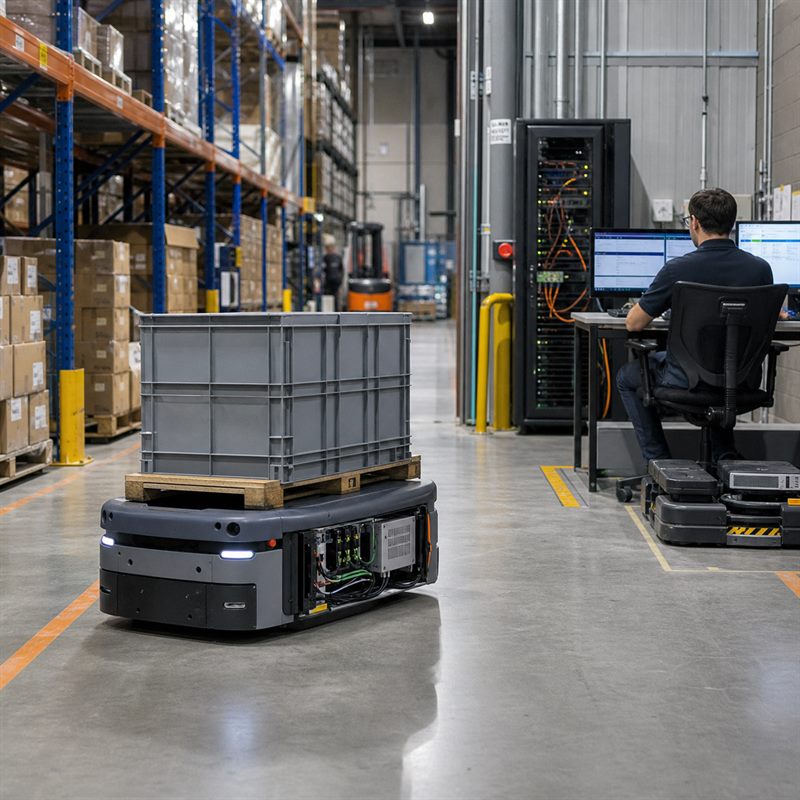
The shift from cloud AI to edge AI is especially important for robots. Machines that move in the physical world need local intelligence because latency, network dependency, privacy, and safety directly affect real-world behavior.
Cloud AI vs. Edge AI: The Practical Difference
Cloud AI centralizes computing in remote data centers. Data is uploaded, processed, and returned. This model is powerful for model training, large-scale analytics, and fleet learning, but it introduces network dependency and response delay.
Edge AI moves computation closer to the device. In robotics, that means cameras, sensors, models, planning, and control decisions can run on the robot or nearby edge hardware instead of waiting for a cloud round trip.
| Factor | Cloud AI | Edge AI for Robots |
|---|---|---|
| Latency | Depends on network transmission and remote processing | Supports faster local response for perception and control |
| Reliability | Can be affected by unstable connectivity | Can continue operating when the network is limited or unavailable |
| Privacy | Often sends data outside the device or site | Can keep sensitive sensor data on the robot or local system |
| Best Use | Training, data storage, fleet optimization, large-scale analytics | Inference, perception, navigation, control, local decision-making |
Why Robots Need Edge AI
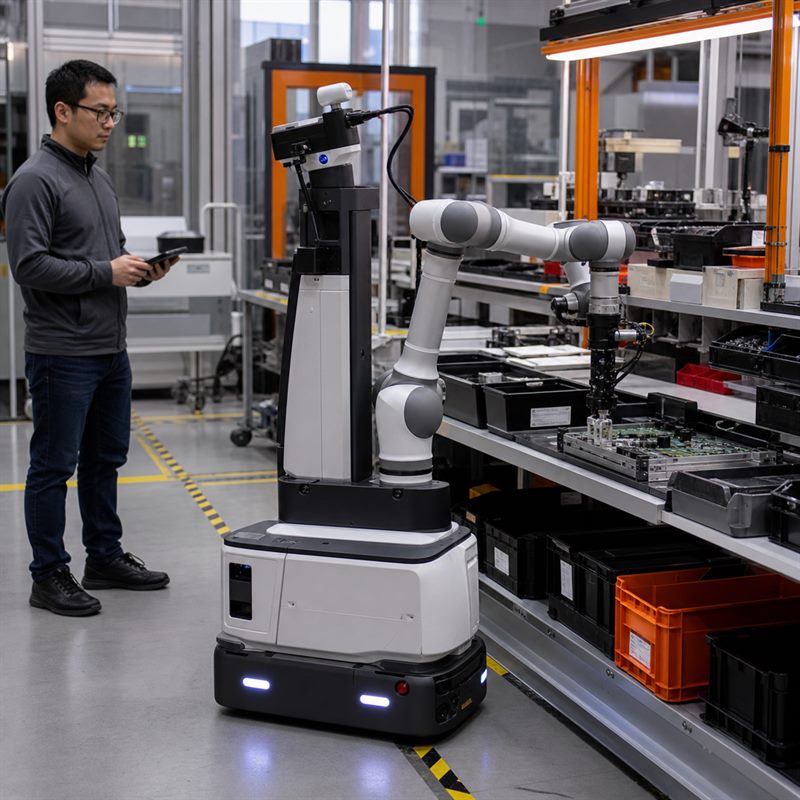
Robots are embodied systems. They do not only generate text or images; they move, lift, inspect, avoid obstacles, balance, and interact with people and objects. A delay that feels small in software can be unacceptable when a robot is moving through a warehouse or controlling a high-DOF arm.
Edge AI helps robots make local decisions for perception, navigation, safety, and control. The cloud can still play an important role, but the physical action loop should not depend entirely on cloud availability.
The Cloud-Edge Collaboration Model
Model training, fleet-level learning, data management, simulation, remote updates, and long-term analytics.
Local inference, sensor fusion, navigation, task execution, motion control, safety response, and real-time decision support.
What Edge AI Hardware Must Support
- AI inference for vision, language, localization, planning, or multimodal workloads.
- High-speed sensor data intake from cameras, lidar, IMU, encoders, or industrial devices.
- Stable local operation under heat, vibration, power limits, and mechanical constraints.
- Communication with control systems, actuators, wireless networks, and fleet platforms.
- Real-time or near-real-time response for safety-critical robot behavior.
Short Answer
Cloud AI is best for large-scale training and fleet intelligence. Edge AI is essential for robots because local inference and control reduce latency, improve reliability, protect data, and help machines act safely in the physical world.
Edge AI in Embodied Intelligence
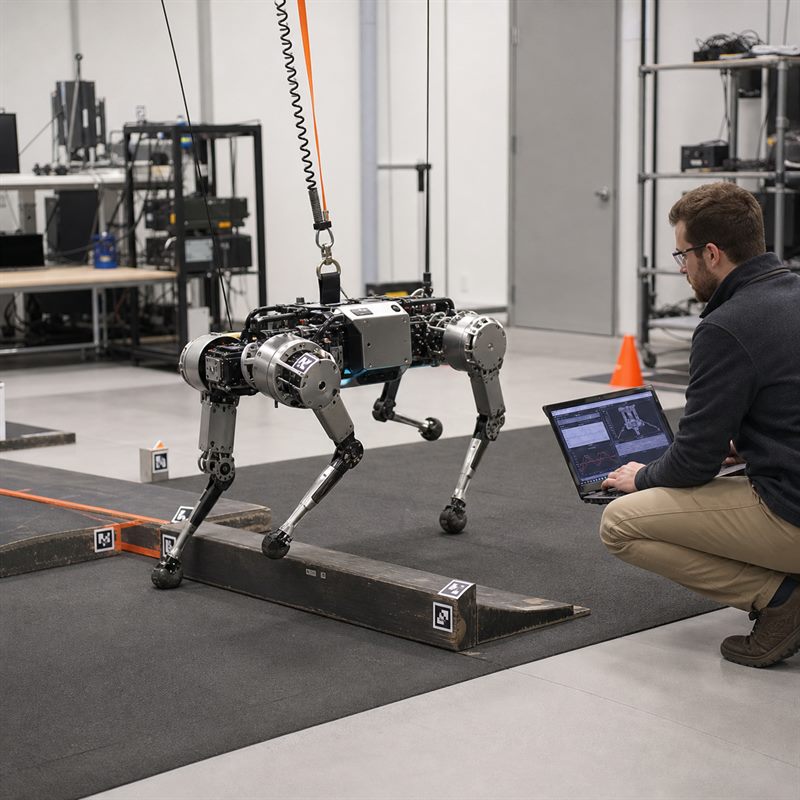
Embodied intelligence requires AI to operate inside machines that sense and act. This includes humanoid robots, quadrupeds, autonomous forklifts, container transport vehicles, drones, and industrial robots. Each system has different compute, sensor, and control needs, but all benefit from moving important intelligence closer to the machine.
Relevant MScape Platforms
- MScape N1000: high-performance robotics edge AI computer for demanding local AI workloads.
- MScape N203: multi-camera edge AI computer for sensor-rich robot perception.
- MScape N201: compact embedded AI computer for connected robot systems.
Application Examples
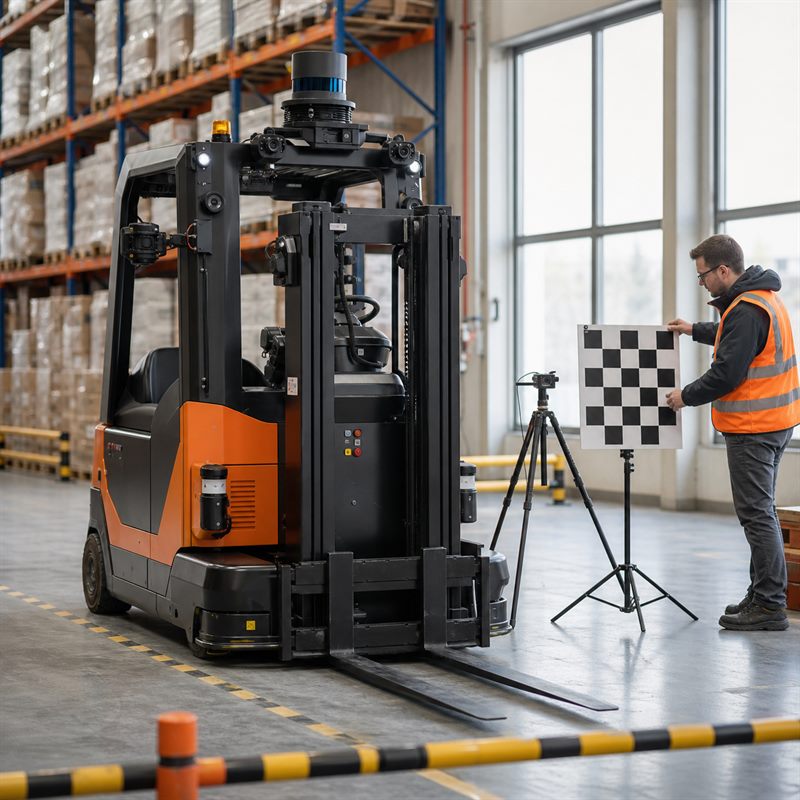
Edge AI computing is relevant for autonomous drones, autonomous forklifts, container transport vehicles, autonomous heavy equipment, and wheeled humanoid robots.
FAQ
Will edge AI replace cloud AI for robots?
No. The strongest architecture usually combines both. The cloud supports training, analytics, and fleet learning, while edge AI handles local inference and real-time robot behavior.
Why is latency so important for robotics?
Robots act in physical space. Delayed perception or control can affect obstacle avoidance, balance, grasping, safety response, and task reliability.
What should teams consider when choosing edge AI hardware?
Evaluate AI workload, sensor count, camera interfaces, thermal limits, power budget, communication needs, real-time control requirements, and the target robot form factor.