English
 Español
 Português
 Deutsch
 한국어
 日本語
 Italiano
 Français
 العربية
 Türkçe

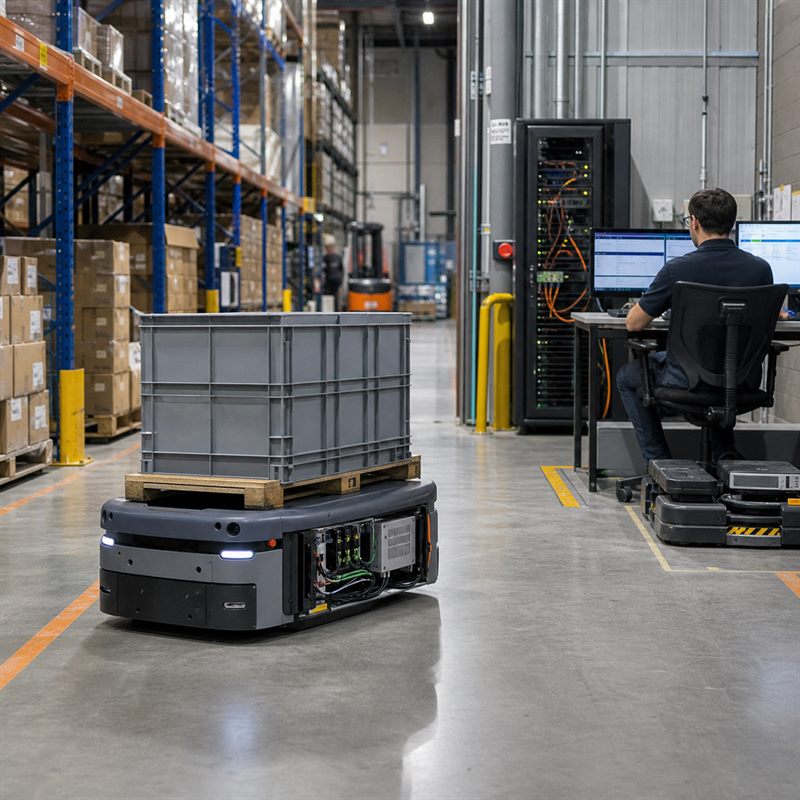
Choose local or cloud processing by what must happen when the network is slow or unavailable. A robot can upload evidence later; a task using a current observation may not be able to wait. The two workloads need different failure rules.
Local AI reduces a network dependency for the selected task. It does not automatically make the result timely, accurate or safe. Those qualities still depend on the local data path, application and robot architecture.
Divide the work by its deadline and failure response
| Work | Possible location | Question to answer |
|---|---|---|
| Current perception and task estimates | Robot or nearby controlled compute | What happens when an observation is late or missing? |
| Evidence retention and delayed upload | Local buffer plus remote archive | How much disconnected history must be retained? |
| Model training and fleet analytics | Remote infrastructure where appropriate | How are versions and results returned to the robot? |
| Safety functions | Dedicated designed system | What independent validation does the machine require? |
This is a planning framework, not a rule that every robot needs the same partition. Some task systems permit remote assistance with a defined pause; others require local continuity. Specify the operating behavior before choosing the connection.
A latency budget exposes the dependency
Suppose a task allows 150 ms from capture to result use. An assumed local preprocessing and inference path takes 45 ms, downstream handling takes 15 ms, and a remote round trip would add 120 ms. The serial total is 180 ms before additional waiting, exceeding that example budget.
These values are illustrative, not measured network or product results. Test the actual latency distribution, including reconnects and congestion. The local path also needs a load test because queues, image copies and recording can consume the apparent saving.
A useful budget separates three times: capture to local decision, decision to robot action, and event to remote receipt. Suppose the application needs a fresh observation before moving past a checkpoint. If the network drops for ten minutes, delaying the first two times until reconnection would change the task; delaying the remote receipt may be acceptable if local storage and operator rules allow it. These are example boundaries, not measured results or a promise that a particular robot can operate offline.
Draw the data path for each task. Navigation or inspection decisions that rely on the current scene may stay local; fleet scheduling, fleet-wide analytics and evidence review can often tolerate a later exchange. Ask who owns the pause or safe-state decision when local input is also unavailable. A computer with local inference cannot replace a missing camera, a motion controller or the application’s failure policy.
Budget for disconnected evidence
If retained evidence averages an assumed 4 Mbit/s, one hour without upload produces about 1.8 GB of payload in decimal units. Account separately for metadata, storage reserve and bursts. Define what can be deleted, which incidents are protected and what happens near the limit.
On reconnect, new evidence and the backlog share resources. Confirm that uploading does not delay perception, and use identifiers so a retry does not create a duplicate event. A restored connection does not mean the archive is already complete.
Delivery and freshness need separate settings
The ROS 2 QoS documentation describes delivery policies and compatibility. A perception subscriber may prioritize fresh observations, while an archive needs a different retention or delivery policy. Reliable delivery cannot make an overloaded consumer catch up.
Keep the permitted frame loss, result-age limit and storage behavior with each task. Do not force every branch through the same policy just because the source camera is shared.
Before the test, set a bound on stored events and a rule for reconnecting. Preserve event IDs and capture times so the server can distinguish delayed evidence from a new event. Check the storage-full case as well as a short outage: does the recorder stop cleanly, discard the oldest permitted item, or block the live task? The answer must be chosen for the robot’s evidence and safety requirements, then verified with the installed workload.
Run the same route once with normal connectivity and once with a controlled outage. Compare task completion, local decision age, alerts, storage growth and what the operator sees. Restore the connection and confirm that backlog upload does not make live perception late. Keep the configuration and raw logs with the result. If you are considering an N201 for local computation, the offline behavior still depends on the software, sensors, storage and robot policy around it.
Test the network loss with the robot workload active
Run the intended local task, remove connectivity under a controlled procedure, and inspect task state, retained evidence and warnings. Restore the link, verify backlog handling and repeat with recording active. Preserve the software versions and configuration used for the result.
MScape’s N201 is one N Series platform to assess for connected onboard AI. The tested workload and installed communication requirements determine whether it fits.
For a fleet-level extension, use the configuration review to share local tasks, connectivity assumptions, evidence rate and disconnected duration. Those inputs make a cloud-edge decision concrete.