English
 Español
 Português
 Deutsch
 한국어
한국어 日本語
日本語 Italiano
 Français
 العربية
 Türkçe
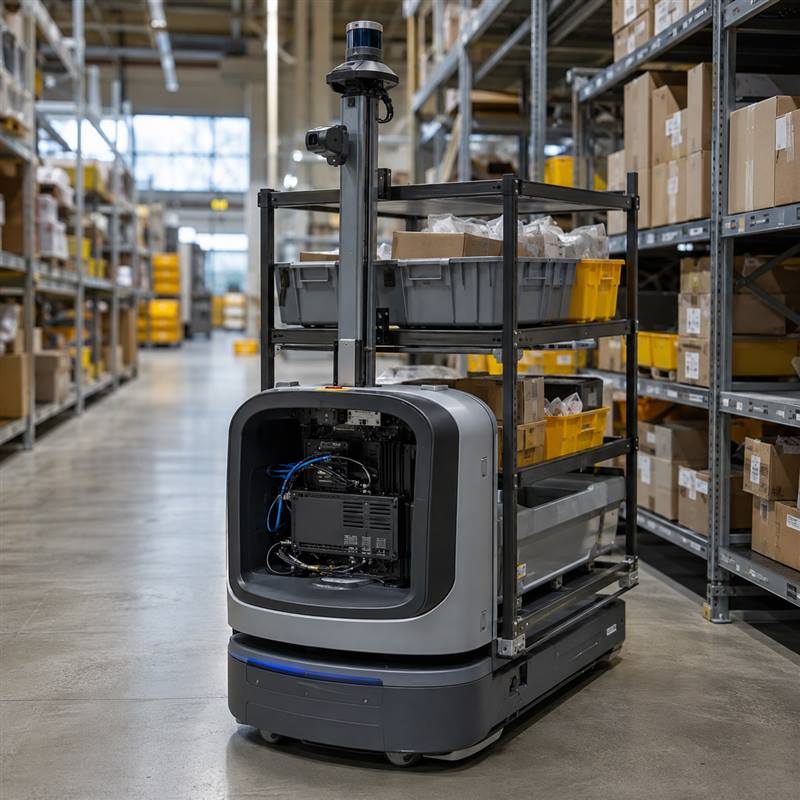
Robotic picking vision has several jobs: find the requested item, provide information for a pick, and help establish what happened afterwards. A recognition result answers only the first part. For warehouse picking, a useful solution connects these observations to the order and the destination, while making uncertain results visible instead of silently counting them as successful picks.
Three questions behind a picking task
Consider a fixed picking station moving items from a source tote into an order container. This is an illustrative workflow, not a customer case or a tested performance claim. The important distinction is between identifying an item, preparing an action and confirming its outcome.
| Stage | Question to answer | Information the application needs |
|---|---|---|
| Find | Which visible item matches the task? | The intended item identity and a usable observation of the source tote |
| Prepare | Is there enough information to propose a pick? | Relevant position or surface information, together with the selected gripper’s requirements |
| Check | What evidence supports the recorded result? | An agreed observation of the held item, destination or other application-specific feedback |
The final row matters because commanding a movement is not the same as completing the business task. A closed gripper does not, by itself, prove that the correct item reached the correct container. The project needs an explicit definition of completion.
Why a clear demonstration may leave questions unanswered
An easy-to-see item in an uncluttered tote is a useful starting point, but it does not describe every intended order. The design discussion should also consider items that overlap, packaging that hides useful features and a tool that blocks the camera’s view.
These are questions about the scene and the task, not reasons to assume a bigger processor will solve the problem. If the identifying feature is hidden, another observation may be needed. If the visible surface is unsuitable for the chosen gripper, better recognition alone may not make the object pickable.
Keep a small set of representative task descriptions: item type, source arrangement, expected destination and what counts as an uncertain outcome. These are requirements for the integrator, not instructions to run unapproved fault tests on a working robot.
Choose a view for each question
A view over the source tote may help locate candidates. A closer view may help examine a selected item. A destination view may support checking the result. Whether all three are needed depends on the task and any feedback already available from the equipment.
A further camera should have a named purpose. It should not be added simply because the computer has another input. For the tradeoffs between an external camera and one near the tool, see the camera-layout discussion for vision-guided robotic arms.
Plan an uncertain-result branch
In the example station, suppose the application cannot establish whether an item reached the destination. Automatically marking the order complete hides the uncertainty. Automatically retrying can also be inappropriate if the item may already be there.
A concept-level alternative is to retain the available observation, flag the task as unresolved and use the recovery route agreed with the operator. Another application might obtain a further view before deciding. These are options to discuss, not universal recovery procedures or claims of improved success rates.
Describe what evidence each option adds and who is permitted to decide the next action. This gives operations staff a clearer proposal than a single headline picking-speed figure.
Where onboard AI computing contributes
The computer can host the selected perception application and handle the observations and messages assigned to it. The robot’s motion system, the gripper and the warehouse application have their own responsibilities. Buying computing hardware does not supply those integrations automatically.
Software frameworks illustrate why these roles are separate: MoveIt’s planning scene represents the robot and surroundings for planning. It is not an order-completion record. The warehouse application still needs to define what a completed pick means.
For a proposed multi-camera arrangement, assess the N203 perception-computing option against the actual cameras, software and installed constraints. No compatibility with a specific gripper, warehouse system or robot brand is implied.
Describe the result before comparing hardware
Write down the item to find, the observation needed before picking and the evidence required afterwards. Then use the N Series overview to begin a configuration discussion. If the arm moves between workstations on a mobile base, the mobile-manipulator article covers the additional arrival and observation problem.