English
 Español
 Português
 Deutsch
 한국어
한국어 日本語
日本語 Italiano
 Français
 العربية
 Türkçe
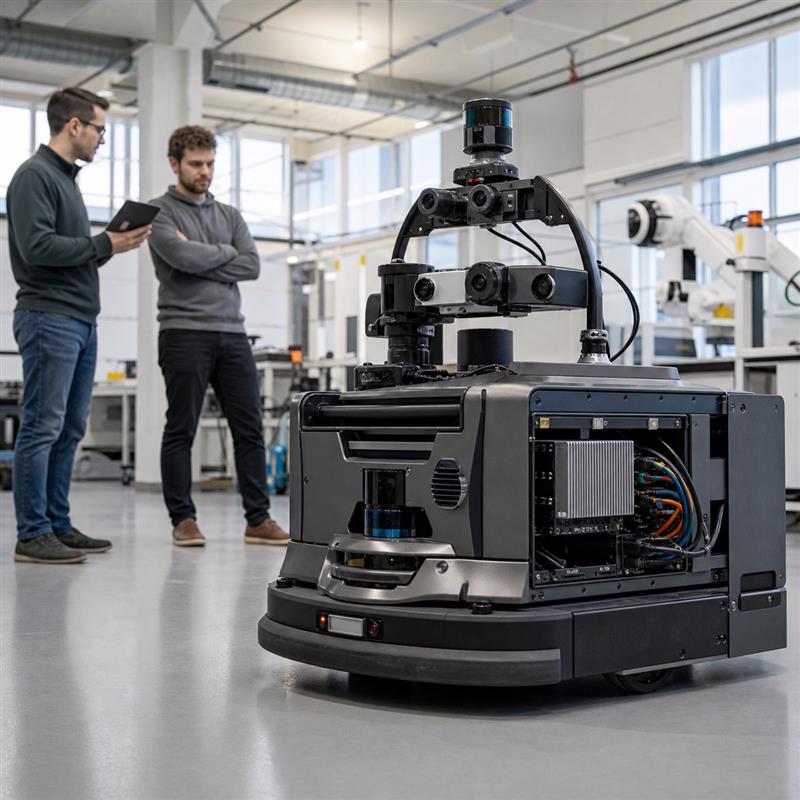
Short answer: an embodied AI computer is robot-side or machine-side hardware that helps a physical machine process sensor data, run AI inference, communicate with the rest of the robot, and support action-oriented workloads. It is not automatically a robot controller: the computer, controller, sensors, actuators, software, and safety architecture still have distinct roles.
What Is an Embodied AI Computer?
Embodied AI is artificial intelligence used by a physical system that must perceive its surroundings, make context-aware decisions, and produce useful action through a robot or autonomous machine. The body may be a humanoid, AMR, autonomous forklift, quadruped, drone, cobot vision cell, or inspection system. What makes the AI embodied is not a particular model or processor; it is the link between computation, physical sensing, and action in the real world.
An embodied AI computer is the hardware placed close to that loop. It can collect camera and sensor streams, run perception or other local inference workloads, support sensor processing and communications, and exchange information with the robot’s wider control architecture. In practice, it is a computer chosen around the machine’s I/O, power, thermal, enclosure, and deployment constraints—not simply a development board selected for an AI benchmark.
For a deeper explanation of how perception data becomes a usable robot view of the world, see MScape’s guide to robot perception and sensor fusion. This article focuses on the hardware role that makes those workloads deployable on a machine.
Embodied AI, Edge AI, and a Robot Controller Are Different Terms
| Term | What it describes | Useful engineering question |
|---|---|---|
| Embodied AI | The application and system purpose: intelligence connected to a physical machine that senses and acts. | What must the robot understand and do in its real environment? |
| Edge AI computer | Where computation runs: close to the data source or machine, rather than only in a remote data center. | Which workloads need to stay on the robot or machine? |
| Embodied AI computer | The robot-side or machine-side hardware selected to support embodied-AI workloads in a physical deployment. | Can the computer carry the sensors, inference, interfaces, power, and packaging required by the machine? |
| Robot controller | A control-system role responsible for robot motion, actuator coordination, and other control functions in the defined robot architecture. | Which certified or designed-for-purpose control components own motion and safety functions? |
Edge AI describes location; embodied AI describes purpose. A camera appliance at the edge is not necessarily part of an embodied AI system, while an embodied AI robot may use a mix of local and cloud resources. Likewise, an edge AI computer is not automatically a robot controller. It may contribute perception, planning inputs, and communication, while separate controllers and safety components own motion and protective functions. This distinction matters when teams map responsibilities, validate interfaces, and assess risk.
What Hardware Does an Embodied AI Robot Need?
The exact architecture is application-specific, but the same engineering categories recur. An autonomous forklift may combine cameras, lidar, vehicle signals, and fleet connectivity. A humanoid may combine many visual inputs, joint-state data, and local AI workloads. A drone must fit the same decisions into a tightly constrained power and mass envelope. Start with the physical system, then translate it into a hardware brief.
Document the models, data paths, concurrency, and future software growth you expect. Match compute headroom to a credible deployment workload, not an isolated headline figure.
List camera type and count, lidar, radar, IMU, encoders, force sensing, audio, and timing needs. Interface availability and cable routing can be just as decisive as raw compute.
Map how sensor streams are timestamped, fused, transported, and shared with the rest of the robot. Include Ethernet, USB, serial, CAN, or other required interfaces in the architecture review.
Validate the real battery or power supply, enclosure volume, cooling path, connector access, vibration exposure, and service plan. A bench arrangement is not a mobile deployment.
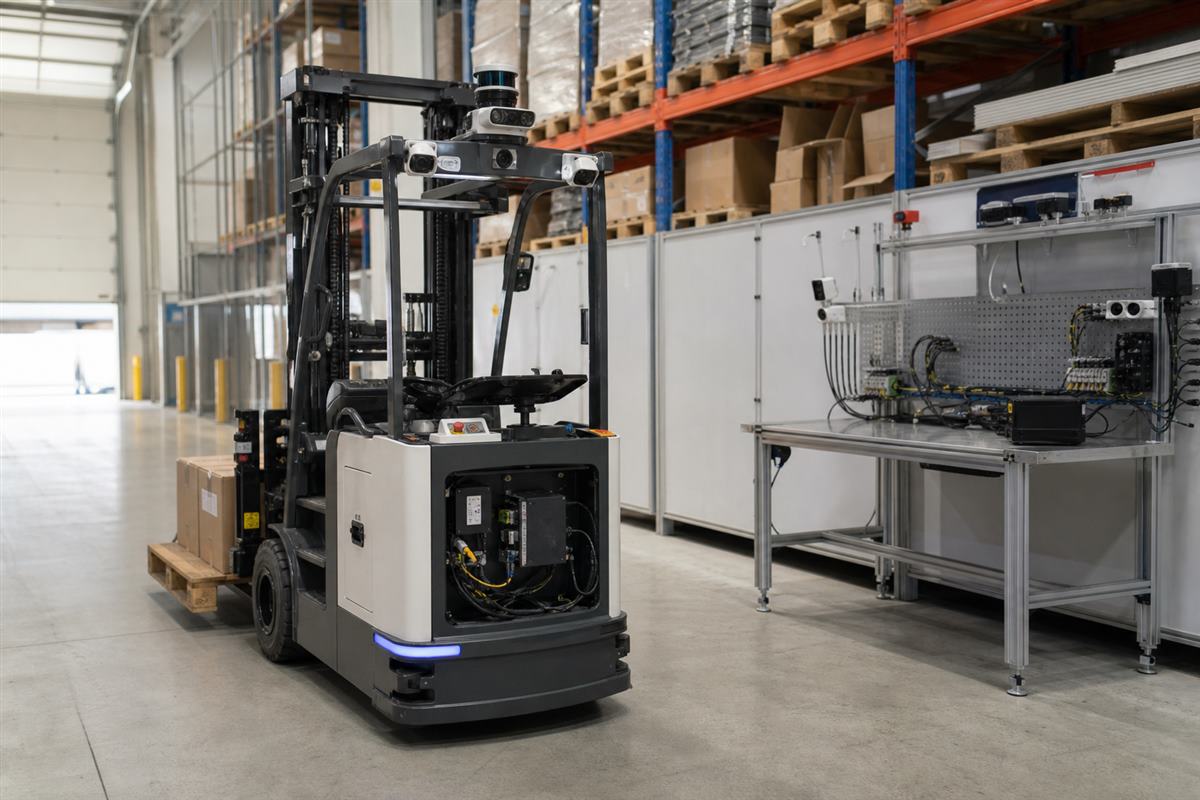
Embodied AI hardware must fit the complete machine: sensing, communication, protected installation, power, thermal management, and maintainable cabling.
Architecture: From Sensor Input to Physical Action
A useful embodied AI computer architecture is a chain of accountable functions. Sensors provide data; the robot-side computer ingests and processes it; models and software produce perception, localization, or decision inputs; and those outputs are exchanged with the robot’s defined control and actuation layers. The hardware does not replace every part of that chain. It gives the integration team a practical place to run the appropriate robot-side workloads and connect them to the rest of the system.
That is why interface planning should happen alongside model planning. A team may have enough AI compute in principle but still face an integration bottleneck if the camera path, communications, power conversion, thermal design, or access for servicing was left unresolved. MScape’s article on cloud AI and local edge intelligence for robots is a related guide for deciding which work belongs near the machine and which can remain connected to remote services.
Deployment constraints are architecture constraints
On a bench, a robot can run with short cables, open access, stable power, and an engineer nearby. In deployment, the same computer may sit in a sealed chassis, share power with other subsystems, and require repeatable diagnostics after transport or long duty cycles. Engineers should therefore review mounting orientation, strain relief, connector retention, electrical protection, cooling path, remote access, and replacement procedure as part of the compute decision. These are not secondary mechanical details: they determine whether the intended sensor-and-inference workflow can be maintained on the actual machine.
Selection shortcut
Describe your robot’s sensor stack and deployment envelope before comparing hardware. The practical shortlist begins with cameras and sensors, local workloads, interfaces, power and cooling, mechanical mounting, and the boundary between AI compute and robot-control functions.
Where N Series Hardware Fits
MScape positions the N Series as NVIDIA-based robotics edge AI computing hardware for overseas robot projects. For an embodied-AI program, the product choice should follow the robot brief. The N Series product overview is a starting point for the broader range, while the MScape N1000 high-performance robotics edge AI computer is positioned for advanced perception, large-model inference, sensor fusion, and embodied-AI workloads.
Those descriptions identify an appropriate hardware role, not a promise that one computer delivers a complete robot solution. The final fit depends on the planned models, sensor topology, operating conditions, and the overall robot-control architecture. Teams can also use MScape’s robotics application cases to frame the relevant machine category before an engineering discussion.
Questions to Ask Before You Evaluate an Embodied AI Computer
- Which perception, localization, or AI workloads must operate locally on the robot?
- What cameras and non-camera sensors will be present at pilot and production stages?
- Which interfaces connect sensors, networks, diagnostics, and the robot’s control architecture?
- What are the battery, power-conversion, thermal, enclosure, vibration, and service constraints?
- Which functions remain with dedicated motion and safety components, and what information must cross those boundaries?
Clear answers turn a vague “physical AI computer” request into an engineering specification that can be reviewed, tested, and supported. They also help procurement teams compare supplier responses on integration relevance rather than marketing vocabulary alone. For company context before that discussion, visit About MScape.
FAQ
Is an embodied AI computer the same as an edge AI computer?
Not exactly. An embodied AI computer is selected for a physical machine’s perception-and-action workload. Edge AI says that computing is near the data or machine. Many embodied AI computers are edge AI computers, but the terms answer different questions.
Does an embodied AI computer replace a robot controller?
No. An edge AI computer can support perception, inference, communication, and action-oriented workloads, but controller and safety responsibilities depend on the robot’s designed architecture and its dedicated components.
What should an engineering team share with a hardware supplier?
Share robot type, camera count, sensor list, local workload, control and communication interfaces, power budget, enclosure constraints, expected operating conditions, and deployment timeline.
Plan the Robot-Side Compute Conversation
Use the MScape inquiry page to share your robot type, camera count, sensor stack, control bus, compute target, power budget, and deployment timeline. These details make it possible to discuss an N Series hardware fit around the real machine architecture.