English
 Español
 Português
 Deutsch
 한국어
한국어 日本語
日本語 Italiano
 Français
 العربية
 Türkçe
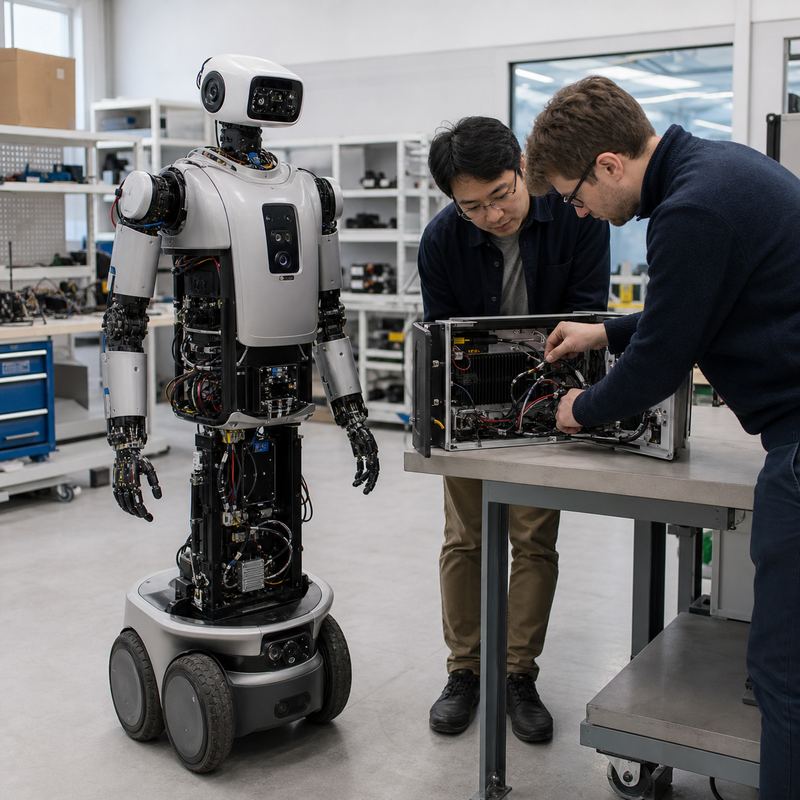
Teams often begin an embodied-AI project by asking whether their vision, language, navigation, or sensor-fusion software can run in the NVIDIA Jetson ecosystem. That is a useful first filter, but it is not enough to choose an NVIDIA Jetson computer for an embodied AI robot. A robot must acquire and move physical-world data, execute its selected workloads, exchange information with the rest of the machine, and remain diagnosable after installation.
For this article, ??mbodied AI??describes AI used in a physical machine that senses and acts in its environment. ??dge AI??describes where computing happens: close to the data source or machine. A robot-side edge AI computer may support perception, inference, sensor processing, logging, and communication; it is not automatically the robot controller. Dedicated motion, drive, and safety responsibilities still need explicit ownership in the robot architecture.
Start with the robot workload, not the Jetson name
The NVIDIA Jetson ecosystem gives robotics teams a familiar route for GPU-accelerated embedded computing and software integration. The engineering question is whether the complete computer and installed design satisfy the robot?? own constraints. A mobile robot with several cameras has a different decision path from a compact inspection machine, a drone, or a wheeled humanoid with manipulation workloads.
| Decision area | Questions to validate before hardware selection | Why it matters in an embodied robot |
|---|---|---|
| Perception inputs | Which cameras, depth sensors, lidar, IMU, or robot-state sources enter the computer? What interface, cable route, and synchronization assumptions apply? | A compatible runtime cannot recover data that is missing, unreliable, incorrectly routed, or hard to service. |
| AI workload | Which models run locally, at what stages, with what pre-processing, post-processing, logging, and fallback behavior? | ??uns the model??says little about the surrounding software and diagnostic work required on the robot. |
| System interfaces | What messages cross Ethernet, CAN, serial, or other defined interfaces? Which subsystem owns each response? | Clear boundaries prevent an AI-compute task from being mistaken for a dedicated control or safety function. |
| Installation | Where will the computer sit, how is it powered and cooled, and how are cables retained, labelled, and accessed? | Bench success can fail after vibration, heat, restricted airflow, cable strain, or difficult maintenance access appear. |
Translate an embodied-AI concept into an installed compute brief
A practical brief separates the machine into observable handoffs. List what enters the robot-side computer, what it must do with that information, what it sends onward, and what happens when an input is degraded or a connection disappears. This makes the evaluation useful to robotics engineers and procurement teams alike.
- Map sensing: document every camera, sensor, positioning feed, robot-state source, and its physical connection.
- Place workloads: identify what must run locally, what can remain elsewhere, and what data must be recorded for diagnosis.
- Define handoffs: state which outputs the computer publishes and which dedicated subsystem owns motion, drive, protective, and operational decisions.
- Design the installation: review power entry, thermal path, connector retention, enclosure access, and service workflow before purchase approval.
Common failure modes that model compatibility misses
| Failure mode | Early check | Better evidence |
|---|---|---|
| The demo works with one sensor but the production sensor set changes data handling. | Run the intended input topology, not a substitute bench camera. | A documented sensor map and recorded test traces from the target interfaces. |
| The compute enclosure fits on CAD but cannot be cooled or serviced in the robot. | Review installed airflow, cable bend space, connector access, and maintenance sequence. | Physical-fit review followed by an installed thermal and service test appropriate to the machine. |
| Software messages blur perception output with machine-control ownership. | Assign an owner and acceptance criterion to each interface. | An interface contract reviewed by AI, controls, and safety stakeholders. |
| A connectivity interruption leaves operators without useful diagnostic evidence. | Test restart, logging, and recovery paths with relevant links unavailable. | A fault-injection checklist and a reproducible recovery record. |
Where MScape N Series computers fit
After the workload and installation boundaries are clear, MScape N Series hardware can be assessed as NVIDIA-based robot-side computing paths. For camera-rich perception systems, review the MScape N203 multi-camera edge AI computer against the planned camera and sensor interfaces. For sensor-rich robots that need a compact integration path, evaluate the MScape N210 robotics edge AI computer against the defined communication and deployment design. For larger or more compute-heavy embodied-AI workloads, the MScape N1000 high-performance robotics edge AI computer is a separate evaluation path.
No one model is automatically right. A camera-rich system may prioritize its input topology, while a robot with a heavier local workload may require a different balance of compute, installation space, and thermal design. Use the N Series product overview to frame the shortlist, then validate the specific model against the installed robot brief. For the wider architectural distinction, see the related guide to embodied AI hardware architecture.
A validation sequence for a Jetson-based embodied-AI computer
- Replay or acquire representative sensor data using the intended interfaces.
- Run the selected local pipeline, including pre-processing, inference, outputs, and diagnostic logging.
- Verify the message boundary with the defined robot software, control, and safety architecture.
- Install the computer with the intended power, enclosure, cooling, and cable-management arrangement.
- Exercise restart, degraded-input, and connectivity-recovery cases; retain the evidence needed for engineering review.
NVIDIA Jetson is an ecosystem and hardware-building-block reference in this evaluation. The test plan must still be matched to the robot, its software, and its complete physical architecture.
FAQ
Is NVIDIA Jetson the same as an embodied AI computer?
No. Jetson refers to an NVIDIA embedded-computing ecosystem. An embodied AI computer is a complete robot-side or machine-side hardware role that must be evaluated in its sensing, workload, communications, installation, and system-boundary context.
Does a Jetson-based edge AI computer replace a robot controller?
No. It can support perception, inference, sensor processing, communication, and action-oriented workloads. Dedicated control, drive, motion, and safety functions remain responsibilities of the robot?? defined architecture.
What should a supplier validate first?
Share the robot type, camera and sensor stack, model/runtime, required interfaces, installed power and thermal constraints, enclosure layout, service expectations, and deployment timeline. That gives the evaluation a verifiable starting point.
Turn your embodied-AI concept into an engineering brief
For a fit discussion, contact MScape with your robot type, camera count, sensor stack, control-bus boundaries, local AI workload, power budget, installation constraints, and deployment timeline. You can also review MScape?? broader robotics context on the application cases page and its company background on the About MScape page.