English
 Español
 Português
 Deutsch
 한국어
한국어 日本語
日本語 Italiano
 Français
 العربية
 Türkçe
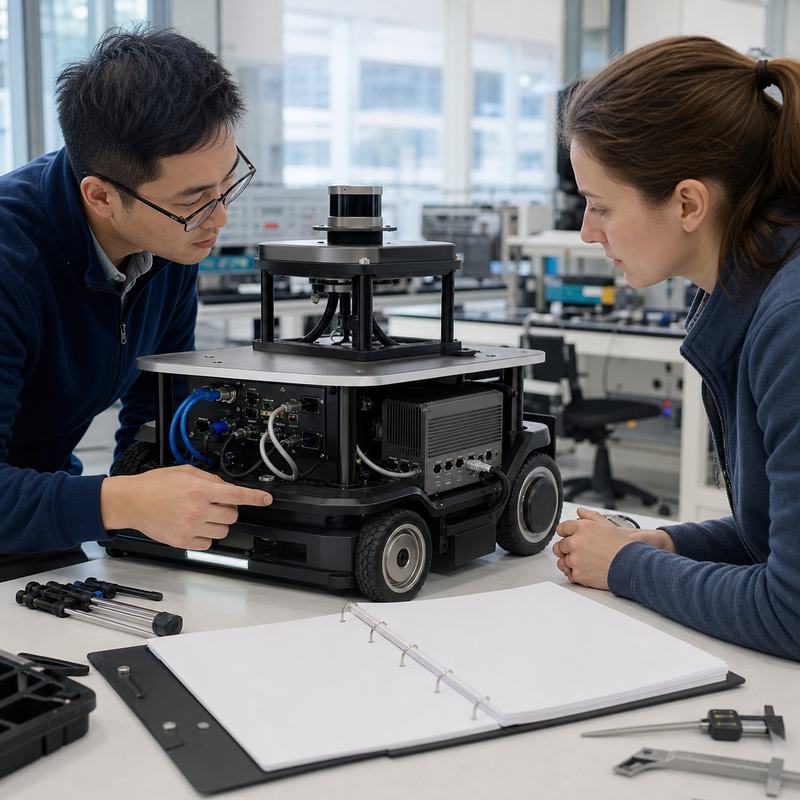
Short answer: evaluate a robot AI computer supplier by asking for evidence that connects the computer to your robot: the intended sensor and interface topology, installed power and thermal design, documentation ownership, validation method, change-control process, and support handoff. A product specification is useful, but it does not by itself prove integration fit.
Choosing a robot AI computer supplier is rarely just a comparison of compute specifications. A robotics team must eventually install hardware inside a physical machine, connect cameras and networks, manage power and heat, maintain a build record, and reproduce the result after an engineering change. Procurement can make that work easier by requesting evidence early—before a quoted configuration becomes an assumed solution.
Start with the robot, not the supplier brochure
Write a one-page application brief before evaluating suppliers. It should state the robot type, sensor set, intended AI workloads, communications, enclosure limits, power source, operating environment, software dependencies, target build date, and who owns each integration task. This gives engineering and purchasing one reference point for every supplier discussion.
It also separates a valid hardware claim from an integration assumption. For example, a camera-rich robot may need an interface review, cable-routing plan, and an installed thermal check; a compute-heavy robot may need a clear workload boundary and a software-image recovery plan. Those are system questions, not generic feature requests.
The evidence checklist to request
| Evidence area | What to request | Why it matters |
|---|---|---|
| Application fit | A written restatement of robot, sensors, interfaces, power source, and deployment constraints. | Shows whether the proposed computer was matched to your actual architecture. |
| Integration boundary | An interface map that identifies camera, network, fieldbus, storage, power, and low-level control ownership. | Prevents a computer selection from being mistaken for a complete control or safety design. |
| Mechanical and thermal fit | Mounting assumptions, airflow or conduction assumptions, connector access, and service-clearance questions. | Bench success can fail once the computer is enclosed inside the machine. |
| Software handoff | Supported operating-system image, dependency/version expectations, recovery method, and change record. | Makes a repeatable build more likely across prototype and production stages. |
| Validation evidence | A mutually agreed test sequence with pass/fail observations, not an unsupported performance promise. | Turns the quotation into a checkable engineering plan. |
| Lifecycle support | Named escalation path, document revision process, spare-part and change-notice questions. | Clarifies what happens after the first integrated unit. |
Distinguish computer selection from robot-control responsibility
An edge AI computer can support perception, inference, sensor processing, communications, logging, and higher-level robot software. That does not automatically make it a motion controller, a real-time controller, or a safety function. Ask suppliers to document the responsibility boundary between the robot-side computer, any dedicated low-level control hardware, and the safety architecture.
This question is particularly valuable when an RFQ mentions industrial communications. A useful response identifies data ownership, physical interfaces, and integration dependencies without turning general communication support into a deterministic-control or safety claim. For a practical installed-system review, see this related guide to validating robotics edge AI computer interfaces.
Use a two-stage evaluation instead of one long checklist
Stage 1: evidence review before the order
Score the supplier’s response against the application brief. Look for specificity: which inputs are assumed, which items remain to be confirmed, what the supplied hardware covers, and what belongs to the robot integrator. A short, explicit list of open questions is more useful than a broad promise of compatibility.
Stage 2: validation after installation
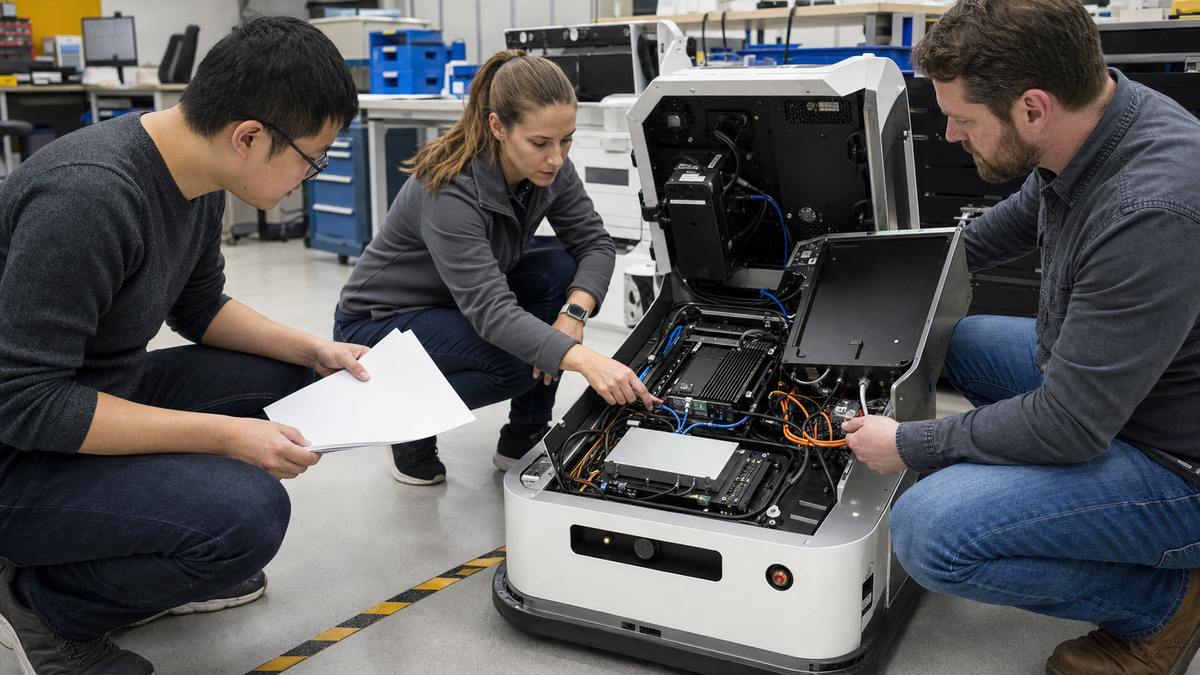
Agree on an installed validation sequence. It can include power-up and shutdown behavior, sensor enumeration, data-path checks, cable retention, enclosure-access review, thermal observation under representative workload, image recovery, and a record of the tested configuration. The goal is evidence for your machine—not a universal result claimed for every robot.
How N Series paths fit into an evidence-led review
After the architecture is defined, MScape N Series computers can be evaluated as robot-side computing hardware. Start from the N Series product overview, then test the model path against the application brief. For a robot that emphasizes sensor fusion and industrial interconnect evaluation, review the MScape N210 robotics edge AI computer with the intended interfaces and enclosure constraints. For compute-heavy robotics workloads, review the MScape N1000 high-performance robotics edge AI computer against the workload, power, thermal, and packaging plan.
Neither is automatically the right fit. If the project’s main risk is a multi-camera input topology, a model path intended for that camera architecture may deserve review first. If the integration brief is still incomplete, choosing a model before mapping interfaces, mounting, and ownership is premature. The application cases can help frame the robot context, while the MScape About page is the place to review company background and current trust information.
Common supplier-evaluation failure modes
| Failure mode | Early warning | Better question |
|---|---|---|
| Specification-only comparison | The RFQ has no sensor, connector, or enclosure details. | “What assumptions connect this configuration to our robot?” |
| Unclear system ownership | One supplier is expected to cover software, controls, safety, and mechanics without a boundary. | “Who owns each interface and acceptance test?” |
| Prototype-only handoff | There is no recovery method or configuration record. | “How will a second unit reproduce the tested image and wiring assumptions?” |
| Late packaging discovery | Mounting, cable bend radius, heat path, and service access appear after selection. | “Can we review the installed layout before finalizing the configuration?” |
FAQ
What should a robot AI computer supplier provide before purchase?
At minimum, request a clear configuration proposal, documented assumptions, interface and packaging questions, software handoff expectations, a validation outline, and a change-control contact. The exact documents depend on the project stage.
Is a product datasheet enough to qualify a robot-side computer?
No. A datasheet helps compare hardware characteristics, but the buyer still needs evidence that the selected configuration fits the robot’s sensors, communications, power, thermal path, mechanical envelope, and integration responsibilities.
When should procurement bring in the robotics engineering team?
Before requesting final pricing. Engineering should review the application brief and open assumptions so suppliers respond to the same system definition.
Send MScape your robot type, camera count, sensor stack, control bus, AI workload, power budget, enclosure constraints, and deployment timeline. Contact the MScape engineering team to discuss an N Series evaluation path.