English
 Español
 Português
 Deutsch
 한국어
한국어 日本語
日本語 Italiano
 Français
 العربية
 Türkçe
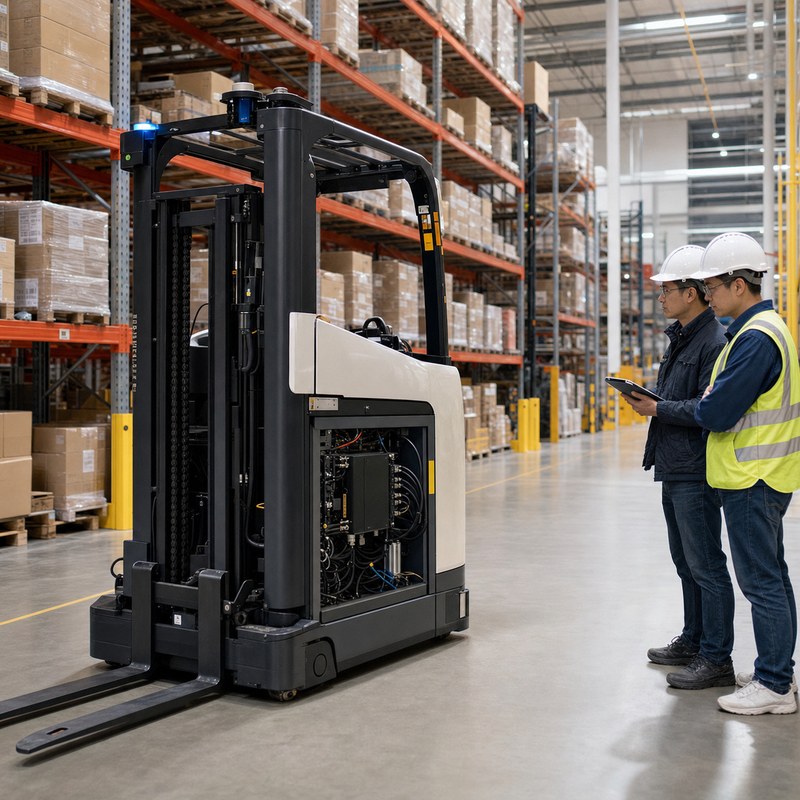
An autonomous forklift edge AI computer should be selected around the vehicle’s sensor layout, local perception workload, interfaces, power and thermal envelope, and validation evidence. In a warehouse, the important question is not simply whether a computer can run a model: it is whether the complete robot-side data path remains understandable and testable when aisles, pallets, lighting, connectivity, and the vehicle installation change.
Short answer
An autonomous forklift edge AI computer is robot-side hardware that can receive camera and sensor data, run local perception and inference workloads, exchange information with the rest of the vehicle, and fit a mobile industrial installation. It does not automatically replace the forklift’s dedicated vehicle-control or safety systems. Start by mapping sensor inputs and ownership, then validate the installed system through representative warehouse conditions.
Why warehouse perception is a system-integration problem
Forklift autonomy commonly brings together cameras, lidar or depth sensing, vehicle-state data, localization inputs, a robot software stack, and fleet connectivity. A bench prototype can be persuasive with a clean camera view and an open enclosure. The deployment can become more difficult after the machine encounters variable pallet placement, occlusion at intersections, reflective wrapping, cable-routing constraints, or a weak wireless area.
That is why compute evaluation should begin with the information path rather than an isolated processor specification. The MScape application cases show autonomous-machine contexts relevant to this discussion, but each forklift still needs an architecture that assigns responsibilities and degraded behavior from its own sensor, vehicle, and safety design.
Keep perception compute, vehicle control, and safety boundaries explicit
| Architecture layer | Typical role | Evaluation question |
|---|---|---|
| Sensor acquisition | Cameras, lidar, depth sensing, IMU, vehicle state, and environment inputs | Are interfaces, timestamps, connectors, routing, and service access defined for the full sensor plan? |
| Robot-side edge AI | Perception, selected inference, sensor-processing inputs, logging, and communications | Can the required workload run inside the actual power, thermal, enclosure, and recovery constraints? |
| Dedicated vehicle control and safety | Machine-specific actuation, low-level control, and safety responsibilities | Are authority, fault handling, and interfaces clearly documented rather than assumed to move into the AI computer? |
| Fleet and remote systems | Supervision, reports, updates, data retention, and offline analysis | Which functions must continue locally when connectivity is interrupted? |
Separating these layers is a practical safeguard. An edge AI computer can support local perception and action-oriented workloads without becoming the vehicle-control system or a substitute for the vehicle’s safety architecture.
Build a forklift compute brief before comparing hardware
A useful one-page brief lists every intended input, its interface, its software owner, its local processing stage, and the expected behavior if that input is unavailable. Add the target workloads: pallet and rack perception, free-space interpretation, localization inputs, obstacle classification, recording, or remote-diagnostics preparation. Then include the mechanical and electrical constraints: available protected volume, connector orientation, DC power behavior, cooling path, cable retention, and maintenance access.
Worked warehouse scenario
Consider a forklift operating across receiving and storage aisles. Forward and side cameras contribute visual coverage; lidar and vehicle-state data add context; the robot-side computer runs the selected perception pipeline and communicates high-level outputs to the rest of the vehicle architecture. Fleet tools may collect logs and coordinate work, but the team must define what remains local during a controlled wireless interruption. The design review should also identify what triggers a defined handoff or stop in the machine’s own control and safety design.
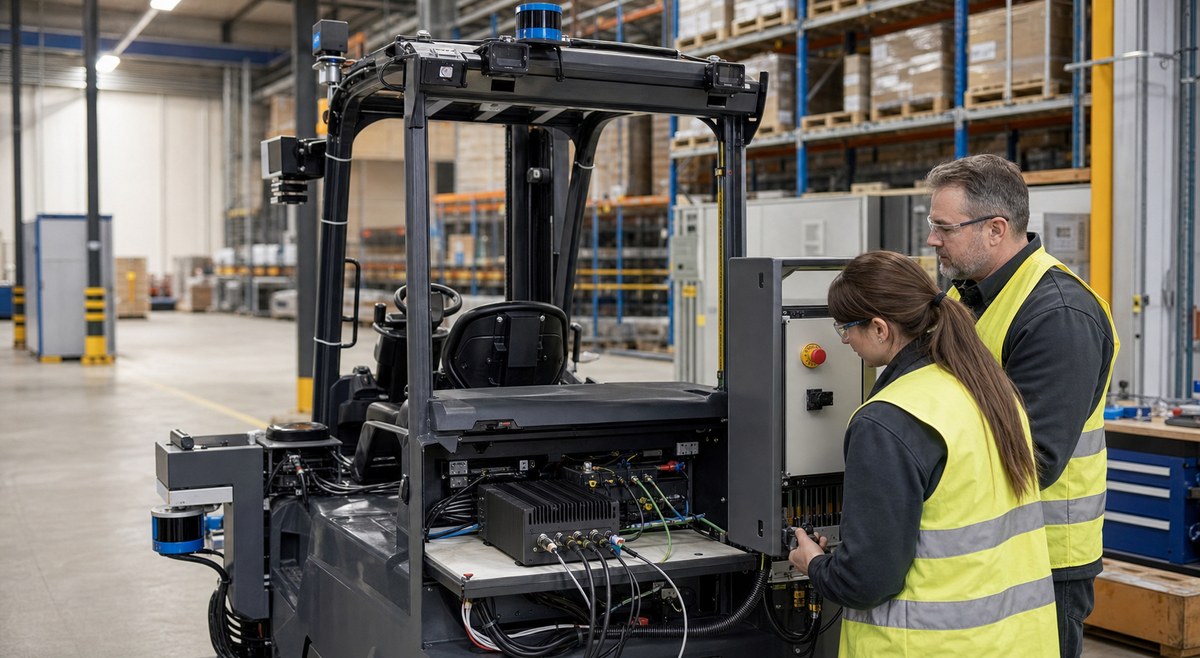
Validate the installed sensor, power, communications, and service path together; a desktop inference demonstration is only one part of the deployment evidence.
Failure modes that a headline compute figure will not reveal
| Failure mode | Why it appears late | Earlier engineering check |
|---|---|---|
| Sensor growth exceeds the original installation | A prototype has fewer cameras or simpler routing than the production vehicle | Reserve interfaces, harness paths, protected mounting, and service access for the intended sensor roadmap. |
| Bench inference does not represent vehicle operation | Heat, power events, vibration, data recording, and cable strain were tested separately | Run the representative workload with the enclosure closed and full sensor set installed. |
| Wireless service hides a local dependency | A remote service unintentionally carries a required function | Exercise the stated local behavior during a controlled connectivity interruption. |
| Control ownership is ambiguous | Broad terms such as “AI controller” replace an interface definition | Document inputs, outputs, authority, and fault response for every subsystem. |
Where N203 and N210 fit after the architecture is clear
Once the sensor and installation brief is complete, MScape N Series hardware can be evaluated as a robot-side compute path. The MScape N203 multi-camera edge AI computer is a relevant option when the forklift architecture is driven by camera-rich perception and related interface planning. The MScape N210 robotics edge AI computer is a relevant option when sensor fusion and industrial interconnect are prominent requirements.
Neither product should be chosen from the vehicle category alone. Compare the actual sensor map, software workload, power and thermal envelope, mechanical installation, and service plan. If the selection task is broader, start from the N Series product overview and the related guide, How to Choose an N Series Robotics Edge AI Computer.
Validation sequence for a warehouse deployment
- Freeze a representative sensor, interface, and workload map, including the next expected sensor change.
- Prove acquisition, synchronization assumptions, communications, and data logging with installed hardware.
- Run the target workloads within the vehicle’s intended power, thermal, enclosure, and cable-routing conditions.
- Exercise defined degraded cases, including a missing sensor, recoverable power event, and controlled loss of remote connectivity.
- Review the evidence with robotics, vehicle, software, safety, mechanical, and procurement stakeholders before release.
FAQ
Does an autonomous forklift edge AI computer replace the forklift controller?
No. It can support local perception, inference, communications, and data handling, but it is not automatically the vehicle’s control or safety system. Define subsystem responsibilities in the actual forklift architecture.
Should every forklift workload run locally?
No. Keep workloads local when the data path, connectivity constraints, or mission behavior require it. Use remote systems for suitable supervision, reporting, updates, and offline analysis. The boundary should be explicit before hardware is selected.
What should an engineering inquiry include?
Share the forklift type, camera count and interfaces, sensor stack, vehicle-control boundary, intended local workloads, power and thermal envelope, enclosure constraints, validation plan, and deployment timeline.
Turn the forklift concept into an engineering review
Planning an autonomous forklift program? Contact MScape with the vehicle type, camera count, sensor stack, control-bus boundary, compute workload, power budget, enclosure limits, and deployment timeline. That gives the hardware evaluation a concrete starting point.