English
 Español
 Português
 Deutsch
 한국어
한국어 日本語
日本語 Italiano
 Français
 العربية
 Türkçe
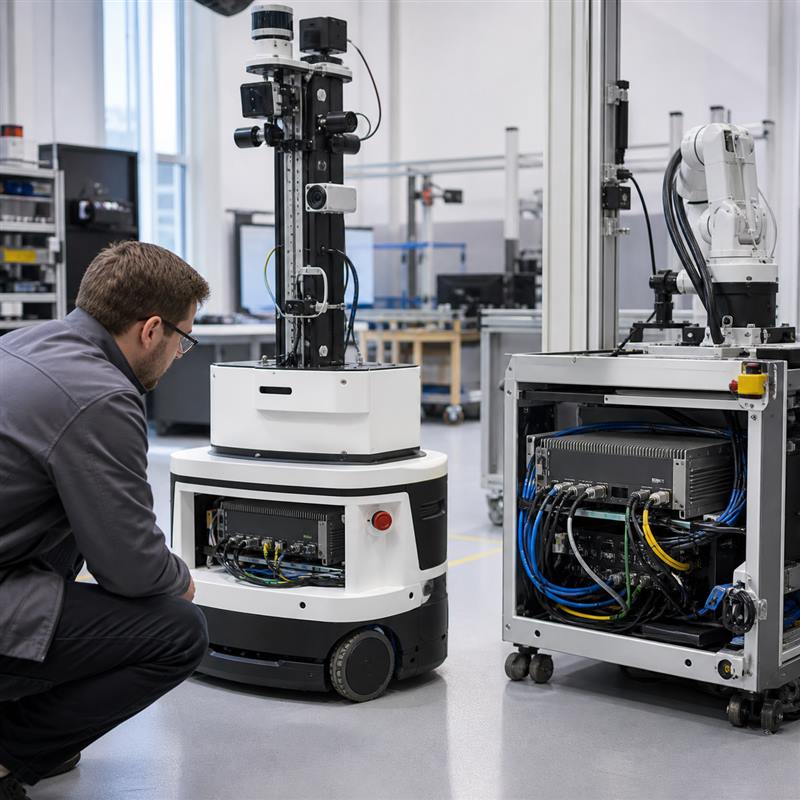
Camera-rich robots and sensor-rich robots can look similar on a requirements spreadsheet, yet they put pressure on different parts of the installed computing architecture. The useful choice is not a model-name shortcut; it is a traceable fit between the robot’s actual inputs, workload handoffs, interfaces, and deployment constraints.
N203 vs N210 is an architecture decision, not a spec-sheet contest
Teams often start by comparing compute capacity alone. That misses the question that causes many late integration changes: what must enter, leave, and remain reliable around this computer in the finished robot? A multi-camera perception design may be dominated by camera topology, cable management, synchronization expectations, and how vision workloads are staged. A sensor-fusion design may be dominated by the mix of navigation sensors, robot communications, protocol boundaries, and service access.
Both paths are N Series robot-side computing hardware built around NVIDIA Jetson ecosystem hardware. They support different evaluation starting points. The right answer comes from a workload map, not from assuming one unit suits every robot.
Start with the robot’s evidence map
| Architecture question | What to document | Why it changes the selection |
|---|---|---|
| Camera path | Camera count, interface type, physical cable route, image-processing owners, and test fixtures. | When multi-camera perception is the central design constraint, it should lead the evaluation rather than be added after the computer is chosen. |
| Sensor and communications path | Navigation sensors, robot buses, networked devices, protocol responsibilities, and where each data handoff is checked. | A robot that must combine several sensor and industrial communication paths needs a clearly owned integration boundary. |
| Workload chain | Which process ingests data, runs inference, shares results, logs faults, and restarts after a service event. | This reveals whether the issue is input integration, concurrent workload coordination, or a wider system-design constraint. |
| Installed constraints | Power input, thermal environment, enclosure, mounting, connector access, and maintenance procedure. | A bench setup can hide cable strain, heat, and serviceability problems that appear in the robot. |
When N203 is the more relevant path
Evaluate the MScape N203 multi-camera edge AI computer first when the robot’s primary engineering concern is bringing a camera-rich perception design into an installed machine. Its verified product positioning includes GMSL2 camera input for multi-camera robotics work. That makes it a useful starting point for teams that must prove their camera configuration, perception pipeline, mechanical cable path, and field service process together.
Examples include a visual-inspection robot, a mobile robot with multiple viewpoints around its chassis, or a cobot cell where vision inputs are the first integration bottleneck. The decision is not simply 鈥渕ore cameras means N203.鈥?It means camera interfaces and perception evidence are the requirements that determine the earliest engineering risk.
When N210 is the more relevant path
Evaluate the MScape N210 robotics edge AI computer first when the system question is broader sensor fusion and industrial interconnect. Its verified product positioning focuses on sensor fusion and multi-protocol robotics integration. That can make it the more relevant path when the team must account for diverse sensor data and communication boundaries alongside local AI workloads.
For example, an AMR may need to coordinate perception data with navigation sensors and the robot’s wider communications architecture. The N210 can be assessed as the robot-side computer for those workloads and exchanges. It is not, by that fact alone, a motion controller or a substitute for the machine’s dedicated control and safety design.
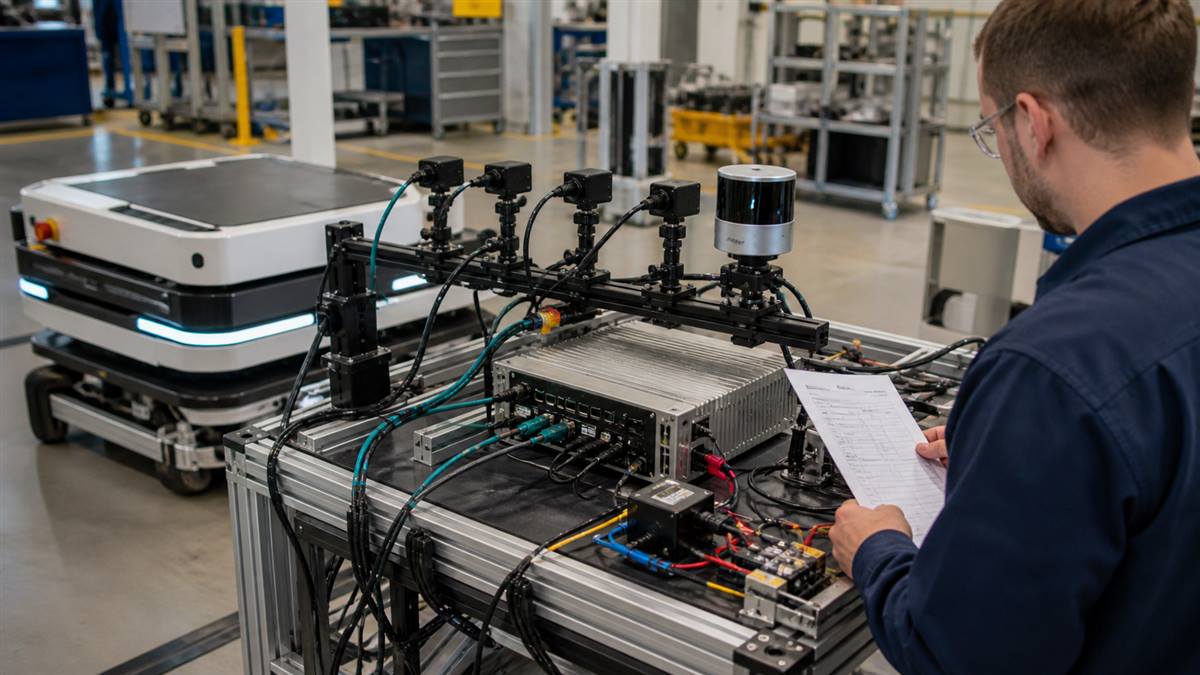
Validate the installed data paths and service access鈥攏ot only the bench inference demo.
A practical N203-versus-N210 decision table
| If this is the leading constraint | Start the evaluation with | Evidence to request or create | Check the alternative when |
|---|---|---|---|
| Multi-camera perception, GMSL2 camera integration, and camera-harness routing | N203 | Camera topology, physical routing, image-ingest test, degraded-camera behavior, and service procedure. | The robot’s sensor and industrial communications mix becomes the dominant integration risk. |
| Sensor fusion, industrial interconnect, and cross-subsystem communication boundaries | N210 | Sensor/interface map, protocol ownership, recovery sequence, and installed network/power test. | Camera inputs and perception topology become the central constraint. |
| Both are significant and the workload grows beyond the initial architecture | Map both paths before deciding | A single test plan showing concurrent inputs, workload handoffs, enclosure conditions, and support responsibilities. | A compute-heavy concurrent workload requires assessment of the N1000 high-performance robotics edge AI computer instead. |
Failure modes that a selection meeting should expose
| Failure mode | What it looks like | Early validation action |
|---|---|---|
| Camera design is treated as an afterthought | The demo works with a simplified camera set, while the installed harness and full perception design are unresolved. | Run the intended camera topology in the target enclosure or a representative mechanical fixture. |
| Interfaces lack clear ownership | Teams can name the connections but cannot say which subsystem checks, logs, and restores each exchange. | Create an interface-ownership map; use the related robotics interface validation guide to structure the review. |
| Bench success is mistaken for deployment readiness | Power, thermal behavior, connector access, cable strain, or service recovery have not been evaluated where the computer will operate. | Complete an installed-system review before locking the enclosure and procurement package. |
| One computer is expected to absorb every responsibility | Perception, higher-level decision workloads, low-level actuation, and safety functions are blurred together. | Document separate responsibilities and preserve dedicated control and safety components where the robot architecture requires them. |
Run a short, decision-ready validation sequence
- List every production camera, sensor, network, and industrial communication connection; mark the physical entry point and the software owner.
- Write the perception and sensor-processing workload chain, including where results are passed to the robot’s other subsystems.
- Test representative inputs in the intended mounting, power, and thermal context鈥攏ot only on an open bench.
- Exercise practical faults such as an unavailable camera, disconnected interface, restart, or service-access event; document how the system detects and recovers.
- Use the completed evidence package to compare the N203 and N210 with MScape engineering, then confirm the product path before purchase.
How this fits the wider N Series choice
N203 and N210 are not universal winners; they are focused starting points. If the robot is primarily a compact connected embedded installation, the MScape N201 embedded AI computer may be the more suitable path to evaluate. If the architecture needs heavier concurrent local workloads, assess N1000 against the complete system evidence. The N Series product overview is the right place to keep the product-family map in view, while robotics application cases help connect the selection to deployment context.
FAQ
Is N203 only for camera projects?
No. It is a relevant first path when multi-camera perception and GMSL2 integration define the engineering problem. The finished selection should still account for the whole robot architecture.
Is N210 a robot controller?
No. N210 is robotics edge AI computing hardware that can support sensor processing, local AI workloads, and communications in a robot architecture. Dedicated low-level control and safety responsibilities depend on the designed machine and its components.
Can one project evaluate both models?
Yes. That is sensible when both camera topology and a wider sensor/communication mix are material. Compare them against one evidence map rather than treating every feature as equally important.
Share your camera count, sensor list, interface map, intended workload chain, power and enclosure constraints with MScape鈥檚 engineering inquiry team. They can help frame the right N Series evaluation path around the installed robot鈥攏ot a generic benchmark.